
🎯 Journey 1: Aling Nena
English Edition — Mastery Learning Refresh
Handa para sa kinabukasan. Ready for tomorrow.
📘 How This Journey Works
Welcome to QualifyMe. This is not a test. This is a path.
You will read Aling Nena’s story across 7 lessons. At the end of each lesson, you will answer 5 quiz questions. You must answer all 5 correctly to continue. If you miss one, your facilitator will give you a kind hint, and you may try again. There is no punishment — only practice.
Your goal: Understand the story. Learn the habits. Earn your Bronze Certification.
Lesson 1: The Rainy Tuesday
The Story
Aling Nena woke before the roosters. She always did.
For twenty years, she had carried taho on a wooden pole across her shoulders — two aluminum buckets swinging at each end, a warm voice calling “Tahoooooo!” through the streets of Lipa. She was a widow. Her husband had passed when Joy was only three. Since then, it had been just the two of them: Nena, the taho, and the long walk before dawn.

She had never written down what she earned. Not once. The money went into a tin can hidden behind the rice sack. When the can felt heavy, she bought Joy new slippers. When the can felt light, she borrowed from Aling Tess. When the can was empty, she told herself, “Bahala na.”
She did not know how much she made on a good day. She did not know how much she needed on a bad one. She only knew the weight of the pole and the ache in her shoulders.
Then came the rainy Tuesday.
The sky opened at 4:00 AM — not a gentle rain, but a wall of water that turned the dirt roads to rivers. Aling Nena stood at her window, the pole leaning against the wall, and watched the street disappear. She could not walk. She could not sell. She could not earn.
By noon, Joy was burning with fever.
Aling Nena reached for the tin can behind the rice sack. She shook it. The sound was thin — a few coins, nothing more. She counted: eighty-seven pesos. Eighty-seven pesos, and her daughter needed medicine, and the rain would not stop, and the taho would spoil by morning.
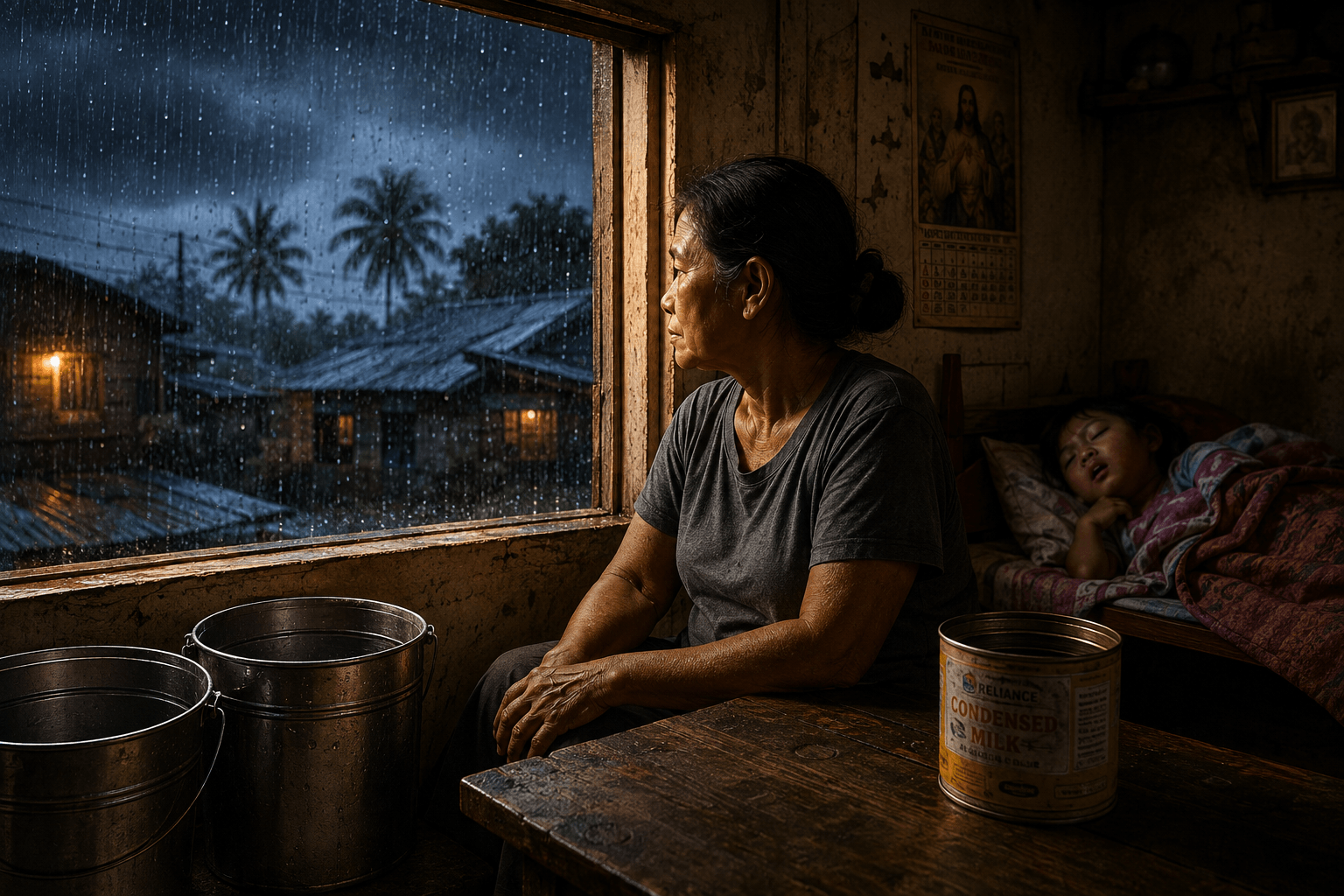
She sat on the floor and cried. Not because she was poor. She had always been poor. She cried because, for the first time, she saw it clearly: she did not know her own number.
And without knowing your number, you cannot find your way out.
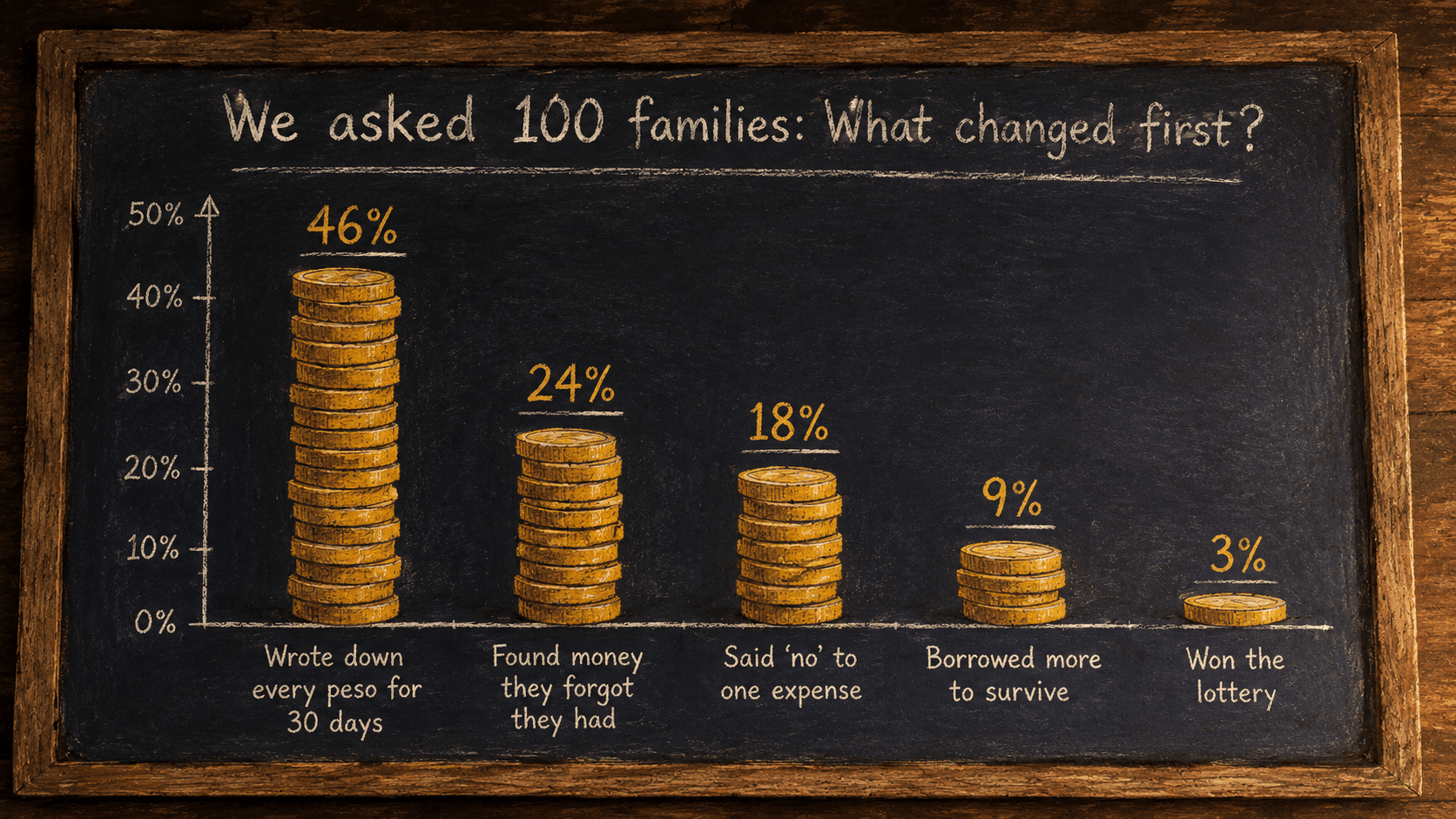
Did you know?
In barangays across the Philippines, 7 out of 10 small vendors do not track their daily income. They rely on memory, feeling, and the weight of the tin can. When emergencies come — and they always come — they have no map. Only panic.
The Coach was a warm woman who sat on a wooden bench outside the barangay hall every Saturday morning. She had kind eyes and hands that looked like they had held many broken things.
She did not give lectures. She asked questions.
“Aling Nena,” she said, “how much did you earn last Monday?”
Nena blinked. “I… I do not remember.”
“And the Monday before that?”
“I do not know.”
The Coach smiled — not a teacher’s smile, but a friend’s. “Then we start there. The number is your map. You cannot find your way out of the forest if you refuse to look at where you are standing.”

📝 Lesson 1 Quiz — Mastery Check
Instructions: Answer all 5 questions correctly to proceed to Lesson 2. If you miss one, your facilitator will give you a hint and you may try again.
What did Aling Nena carry on a wooden pole every morning?
- Fish
- Laundry
- Vegetables
- Taho
How much money did Aling Nena find in her tin can on the rainy Tuesday?
- ₱87
- ₱200
- ₱50
- ₱100
Why did Aling Nena cry on the rainy Tuesday?
- Because she had no food
- Because the taho was too heavy
- Because she saw she did not know her own number
- Because Joy was going to school
According to “Survey Says,” how many small vendors do NOT track their daily income?
- 5 out of 10
- 7 out of 10
- 3 out of 10
- 9 out of 10
What did the Coach say the number is?
- Your punishment
- Your enemy
- Your luck
- Your map
✏️ Result Activity — Lesson 1
Your Turn:
Take a piece of paper. Write down how much money you received or spent today. Do not guess. Write the real number. If you do not know, that is your first clue.
Keep this paper. We will use it again.
When you are ready, proceed to Lesson 2.
Lesson 2: Learning from the Community
The Story
The rain stopped on Wednesday, but the road was still mud. Aling Nena walked slowly, the pole heavier than usual, her mind full of the Coach’s words.
The number is your map.
She passed Mang Turing’s sari-sari store. Mang Turing was seventy-two years old and had run his store for fifty-two years. He sat on a plastic stool, writing in a small notebook — every sale, every purchase, every peso.
“Mang Turing,” Aling Nena asked, “why do you write everything down?”
He looked up, his eyes cloudy but sharp. “Because the paper remembers what the mind forgets. Because when I know my number, I know if I am winning or losing. Because last month, I saw I was spending too much on Coca-Cola. I cut it by half. Now I have extra for my grandson’s school shoes.”
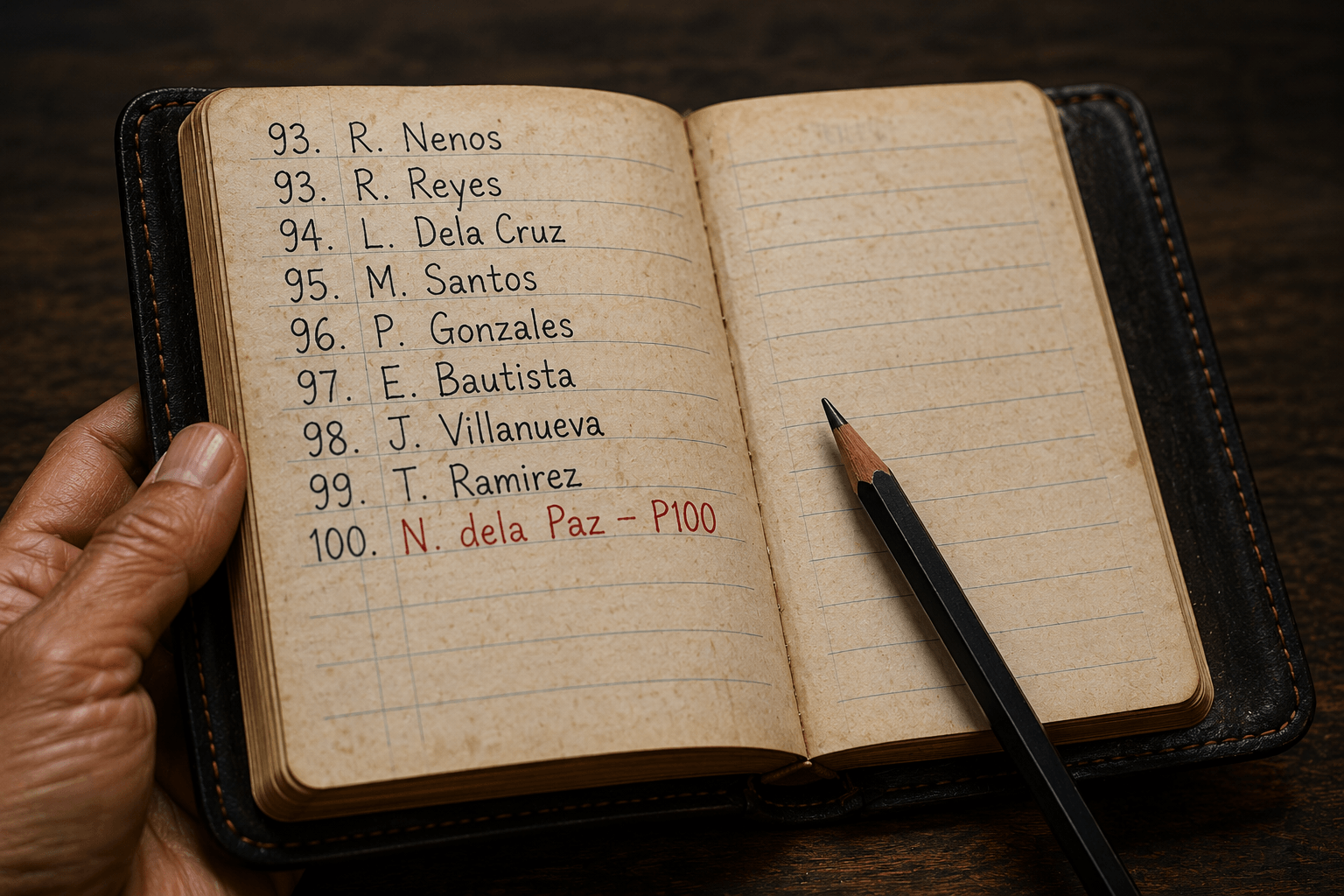
He showed her the notebook. Page after page of small, careful numbers. On one page, a red circle around “#100” — the day he almost ran out of stock but saw it coming because the numbers warned him.
Aling Nena walked on. She passed Aling Tess’s vegetable stall. Aling Tess smiled, but her smile was thin. Her stall was beautiful — stacked tomatoes, bright eggplants, perfect string beans. But Aling Nena knew: Aling Tess borrowed money every month to buy those vegetables. She paid the 5-6 lender every Friday. She never got ahead. She only looked ahead.
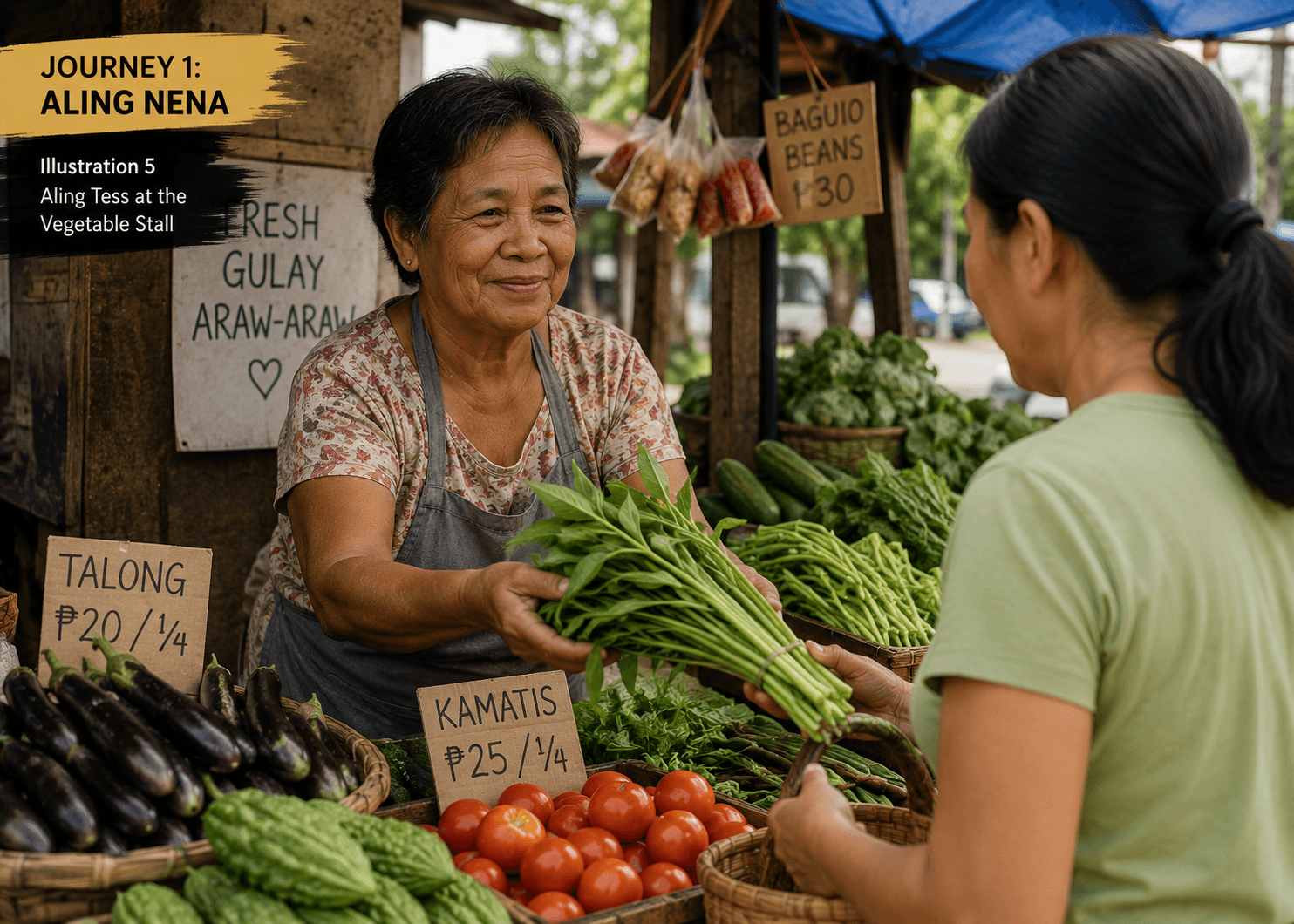
“Tess,” Aling Nena said softly, “do you write down what you earn?”
Aling Tess laughed. “I am too busy selling to count, Nena. I will count when I am rich.”
But she never would be. Aling Nena saw it now. Without the map, you walk in circles.
That evening, Joy’s fever broke. Aling Nena sat at their small table with a pencil and a piece of paper — the back of an old electricity bill. She wrote:
Good day: ₱200
Bad day: ₱80
Medicine: ₱150
Rice: ₱60
Joy’s school: ₱45
She stared at the numbers. They were small. They were honest. They were hers.
For the first time, she saw the gap.
On a bad day, she did not have enough. On a good day, she had extra — but she had never saved it. She had never even seen it.
She went to bed that night with the paper under her pillow. It was not magic. It was not money. But it was real.
And real is where hope begins.
Did you know?
Vendors who track their income for just 30 days report feeling “less afraid” of emergencies — not because they have more money, but because they finally see what they have. Fear lives in the dark. Numbers turn on the light.
The Coach was waiting on the bench. She held a cup of taho Aling Nena had given her the week before.
“You wrote your numbers,” the Coach said. It was not a question.
“Yes.”
“How did it feel?”
Aling Nena thought. “Heavy. But… lighter too. Like I was carrying something true.”
The Coach nodded. “That is the first step. Not saving. Not earning more. Seeing. You cannot fix what you will not look at. And you are not lazy, Nena. You are not stupid. You are tired. The map does not blame you. It only shows you the path.”
📝 Lesson 2 Quiz — Mastery Check
How long had Mang Turing been running his sari-sari store?
- 52 years
- 20 years
- 35 years
- 70 years
Why did Aling Tess never get ahead financially?
- She sold bad vegetables
- She had too many children
- She borrowed from a 5-6 lender and never tracked her income
- She did not work hard enough
What did Aling Nena use to write her first budget?
- A chalkboard
- The back of an old electricity bill
- A new notebook from the store
- Her daughter’s school paper
According to “Survey Says,” why do vendors who track income feel less afraid?
- Because the government helps them
- Because they earn more money
- Because they stop working
- Because they finally see what they have
What did the Coach say was the first step?
- Seeing — looking at your numbers
- Saving money
- Borrowing less
- Earning more
✏️ Result Activity — Lesson 2
Your Turn:
Write down your income and expenses for the last 3 days. Be honest. Do not round up or down. Write the real numbers.
Now circle the biggest expense that surprised you. That is your first target.
When you are ready, proceed to Lesson 3.
Lesson 3: The Saturday Session
The Story
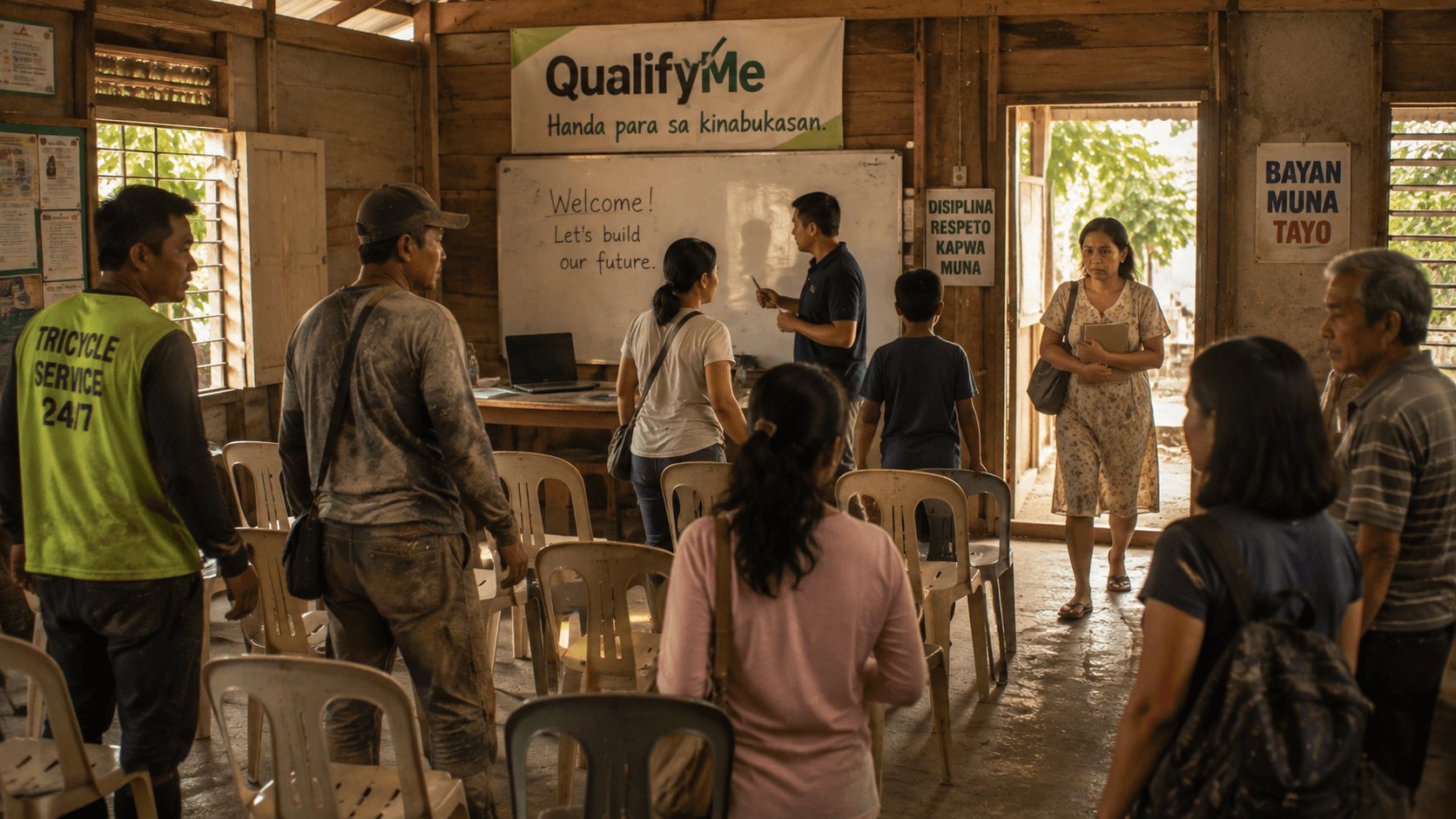
Saturday morning. The barangay hall was already full — plastic chairs scraping against concrete, mothers holding children, old men fanning themselves with newspapers. A banner hung on the wall: QUALIFYME — Handa para sa kinabukasan.
Aling Nena sat near the front, her notebook open on her lap. It was not fancy — just folded paper, held together with a rubber band. But it was hers. Every page had numbers now. Good days. Bad days. Rainy days. She had been tracking for two weeks.
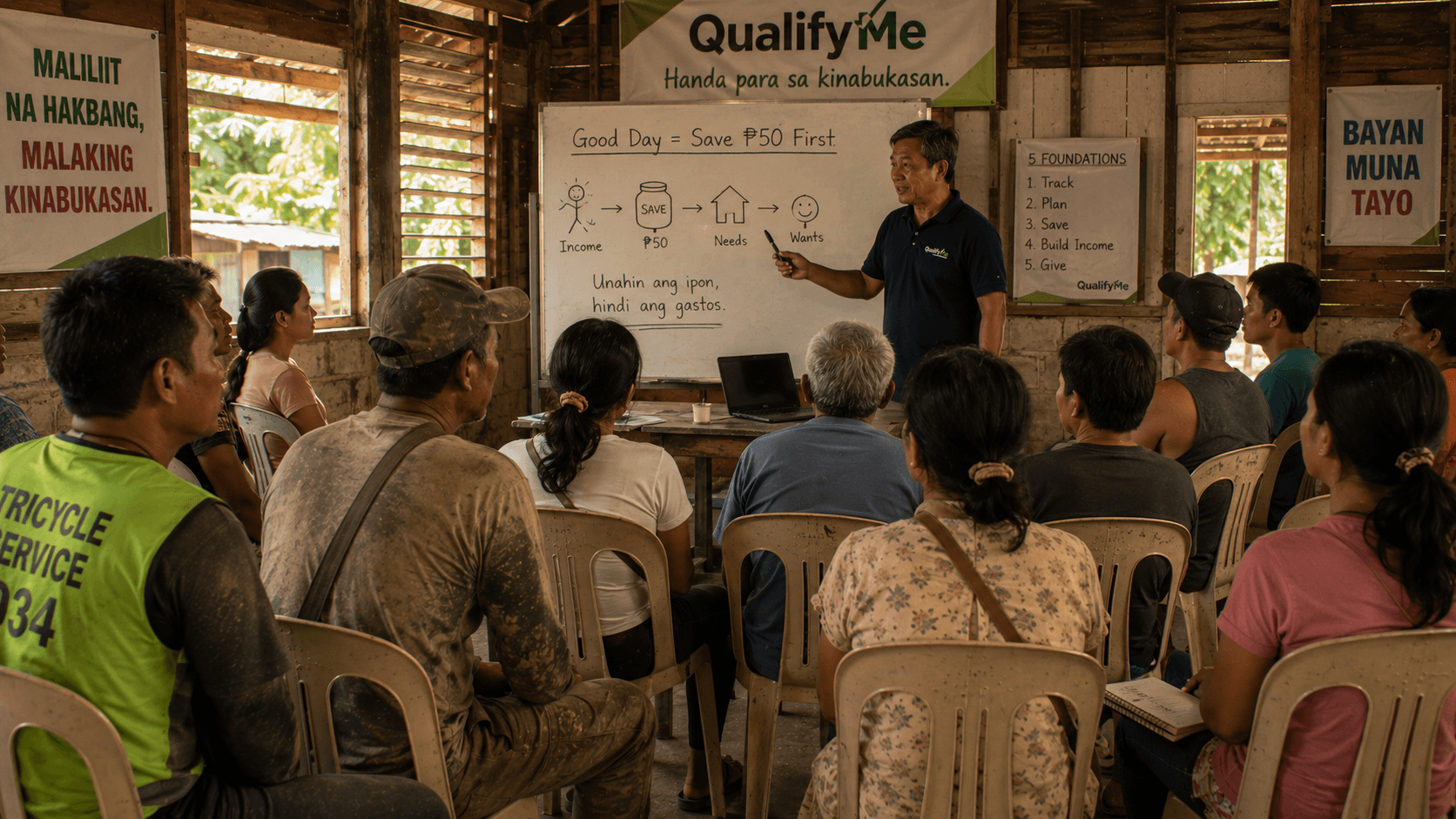
Ran stood at the whiteboard. He was not a professor. He was a man who had learned the hard way, and his voice carried that weight.
“Good morning,” he said. “Today we learn three rules. Not ten. Not twenty. Three. Because three is enough if you do them.”
He wrote on the board:
RULE 1: THE ENVELOPE
Every Sunday, put money into an envelope labeled with the name of a need. Medicine. Rice. School. Do not touch it until the need comes.
RULE 2: HIDDEN MONEY
On good days, hide money where you will not spend it. Not in the tin can. Not in your wallet. A separate place. A secret place. Even ₱20. Even ₱10. It adds up when you are not looking.
RULE 3: GOOD DAY / BAD DAY
Before you sleep, ask: Was today good or bad? If good, save first. If bad, write down why. The pattern will teach you more than any teacher.
Aling Nena wrote the three rules in her notebook. Her hand was slow. Her spelling was not perfect. But the words were true.
“These rules are not magic,” Ran said. “They are walls. Walls around your future. The world will try to knock them down — sales, loans, emergencies, bahala na. Your job is to build them anyway. One brick at a time.”
After the session, the Coach found Aling Nena outside.
“You wrote them down,” the Coach said.
“Yes.”
“Will you do them?”
Aling Nena looked at her notebook. Then at Joy, playing with a piece of chalk on the steps. “I will try.”
“Trying is the first brick,” the Coach said. “Building is what comes after.”
Did you know?
Families who use the “envelope method” — even with very small amounts — are 3 times more likely to handle emergencies without borrowing. Not because they are richer. Because the money is already set aside before the emergency arrives.
“The envelope is not a prison,” the Coach said. “It is a promise. A promise to your future self. When you put ₱50 in the medicine envelope, you are saying: ‘I will take care of you, even if I do not know when.’ That is love. That is discipline. That is what changes everything.”
📝 Lesson 3 Quiz — Mastery Check
How many rules did Ran teach at the Saturday session?
- Ten
- Three
- One
- Five
What is Rule 1 — The Envelope?
- Hide money in an envelope under the bed
- Give envelopes to your children
- Put all money in one envelope
- Put money into envelopes labeled for specific needs
Where should “Hidden Money” go on good days?
- A separate, secret place
- In the tin can
- In your wallet
- To the 5-6 lender
What should you do on a bad day, according to Rule 3?
- Spend more to feel better
- Skip tracking
- Write down why it was bad
- Borrow money
According to “Survey Says,” why are envelope users more likely to handle emergencies?
- They have better jobs
- The money is already set aside before the emergency
- They earn more money
- They do not have children
✏️ Result Activity — Lesson 3
Your Turn:
Take three envelopes or pieces of paper. Label them:
- Emergency
- School / Education
- Food / Rice
Put any amount you can into one envelope today. Write the amount and the date on the outside.
You have just built your first wall.
When you are ready, proceed to Lesson 4.
Lesson 4: The Cooperative & The Tracker
The Story
Week four. Aling Nena’s notebook was half-full now — pages of numbers, small drawings, lists of good days and bad. She was beginning to see herself clearly. And that clarity brought both comfort and fear.
The comfort: on good days, she had more than she thought.
The fear: she had been spending it without knowing.
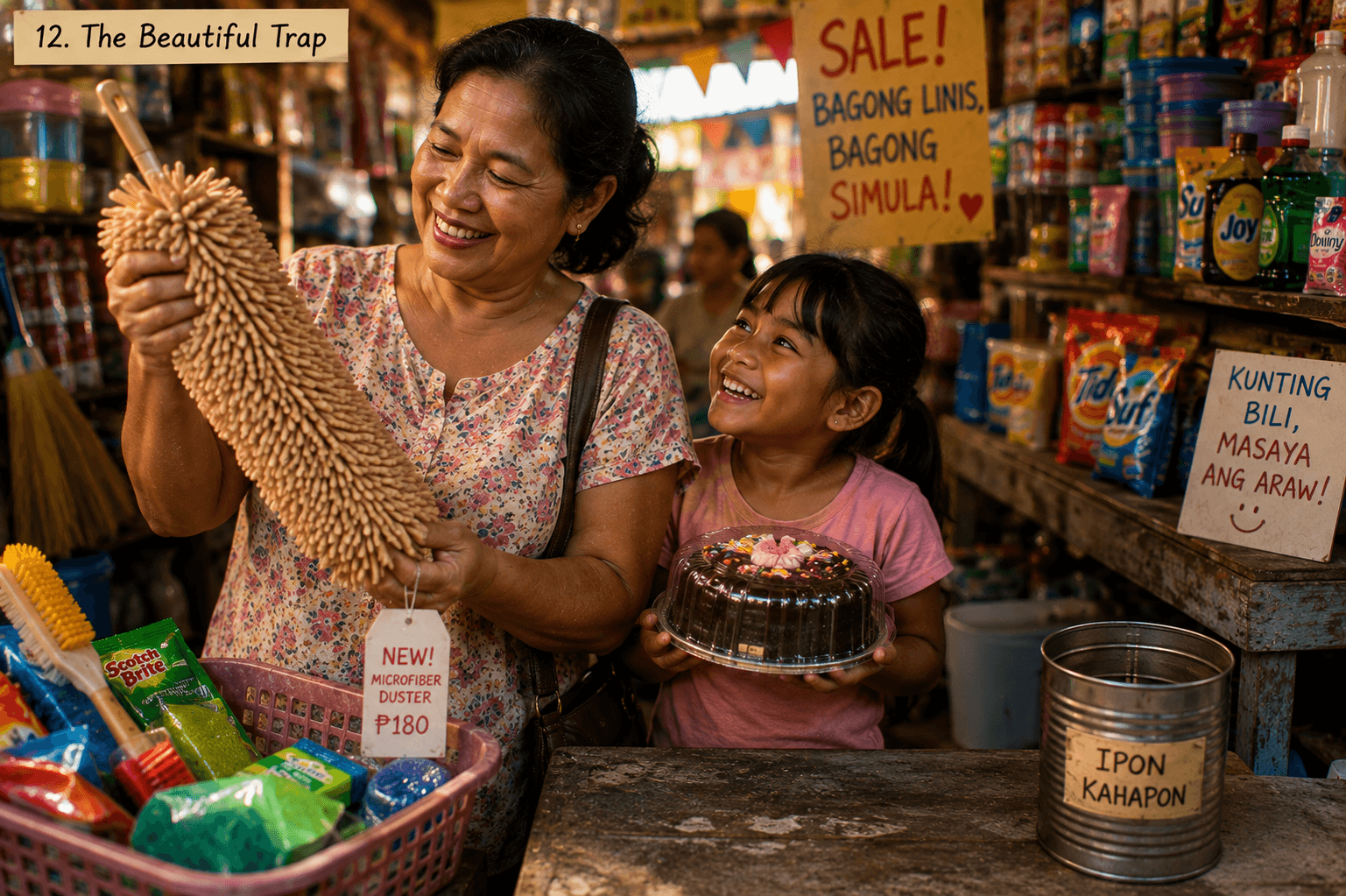
She remembered the Beautiful Trap. Two weeks ago, a woman at the market had sold her a beautiful duster — soft fabric, bright flowers, only ₱180. “You deserve this,” the woman said. And Aling Nena believed her. She bought the duster. The tin can was empty that night. Joy’s school payment was late. The duster hung on the wall, unworn, a reminder of a moment’s weakness.
Then came the Phone. Joy needed a phone for school — online classes, assignments, communication. ₱8,500. Aling Nena had looked at her “IPON” can — the new name she gave her hidden-money place — and found almost enough. But not quite. She was ₱1,200 short. She almost went to the 5-6 lender. Almost.
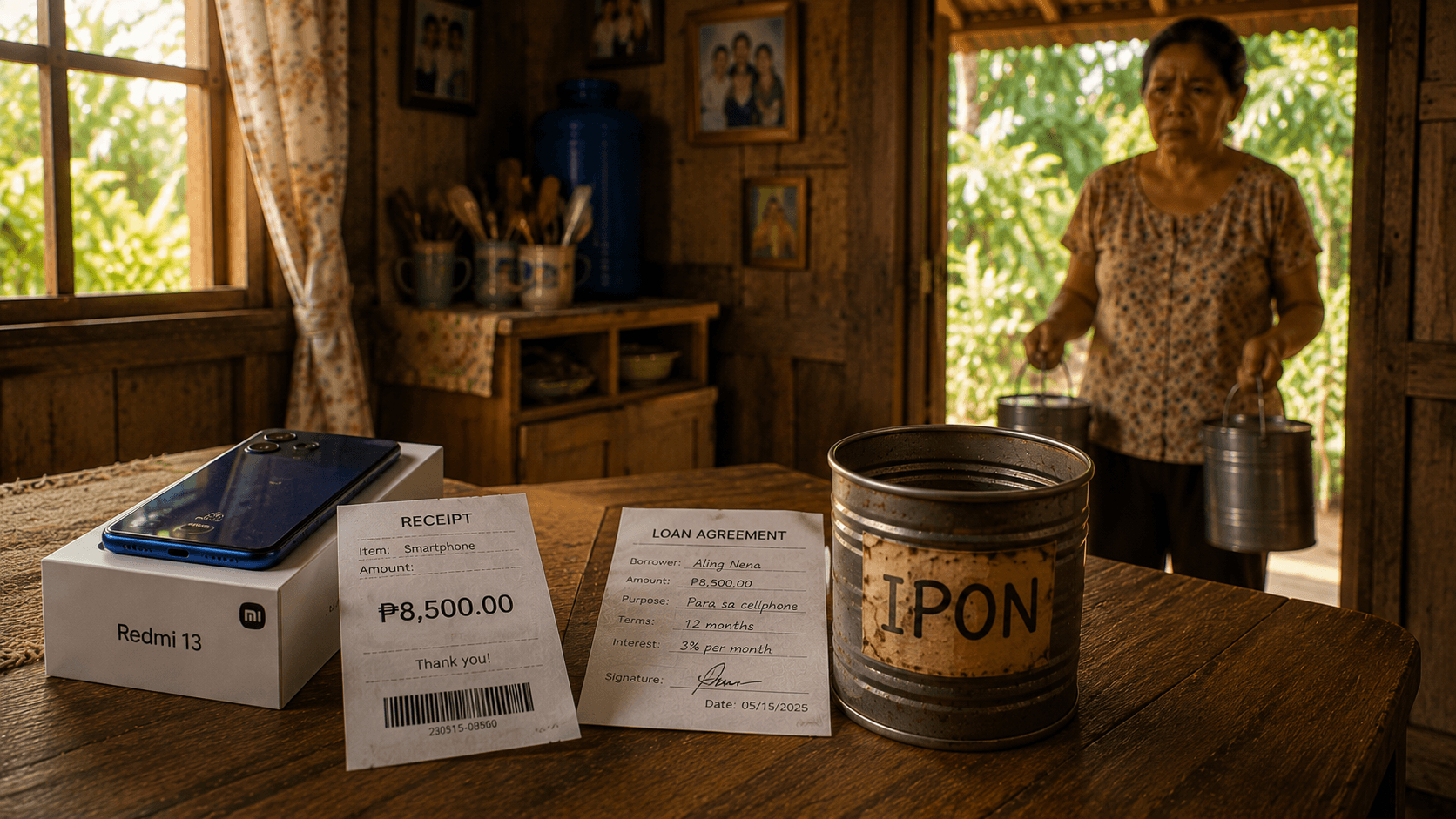
Instead, she waited. She tracked. She saved ₱50 more. Then ₱30. Then another good day brought ₱80 extra. In three weeks, she had the ₱1,200. She bought the phone with her own money. No interest. No debt. No utang.
The Shampoo Bottle taught her too. One evening, frustrated and tired, she grabbed a bottle of shampoo from a sidewalk vendor — fancy label, cheap price. It was fake. It burned Joy’s scalp. She threw it away, crumpling the receipt in her hand. Another lesson: cheap shortcuts are expensive lies.
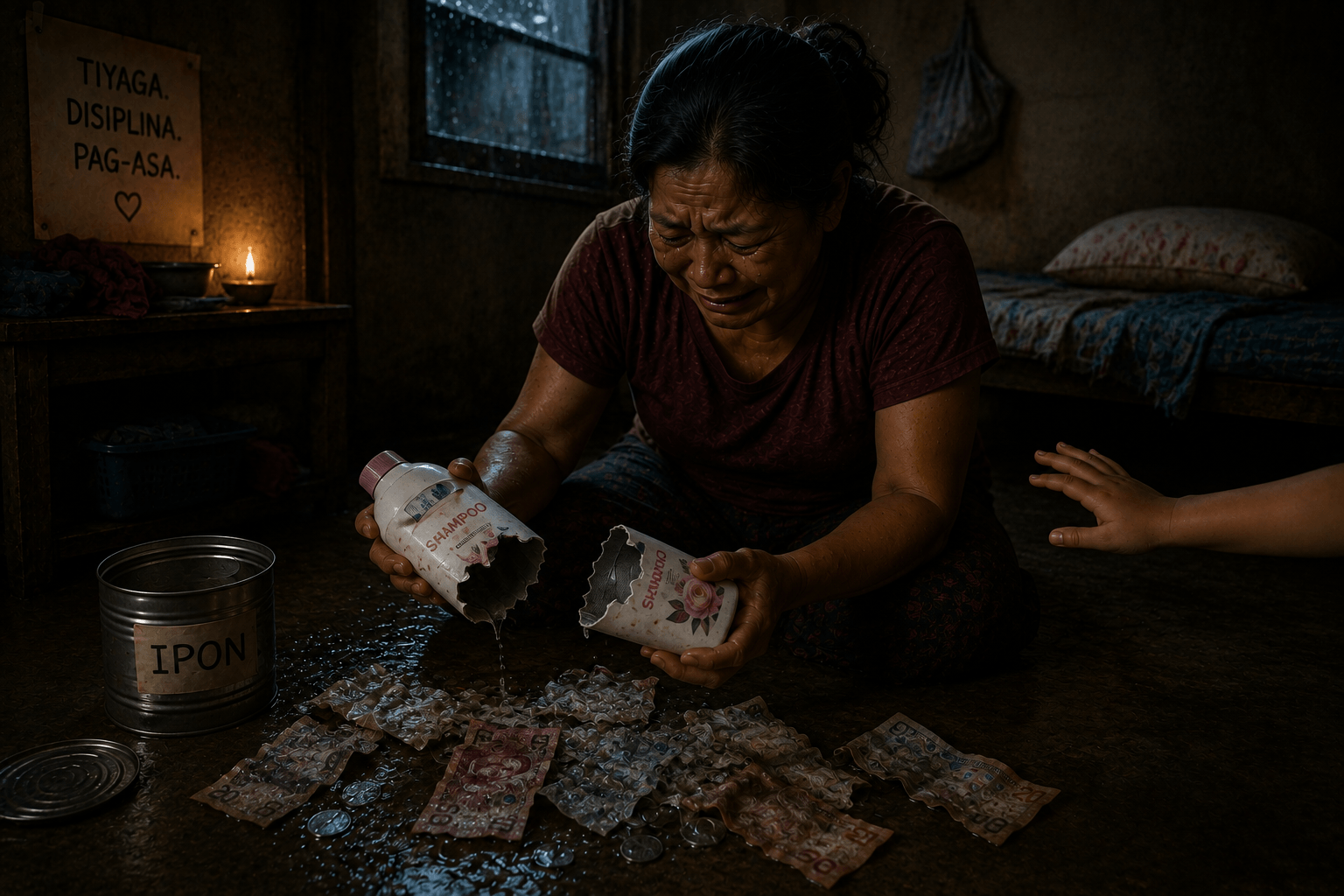
But the biggest change came on a Tuesday morning.
Aling Nena walked into the local cooperative — a small office with a wooden desk, a smiling woman behind it, and a sign that read: “Your savings are safe here.”
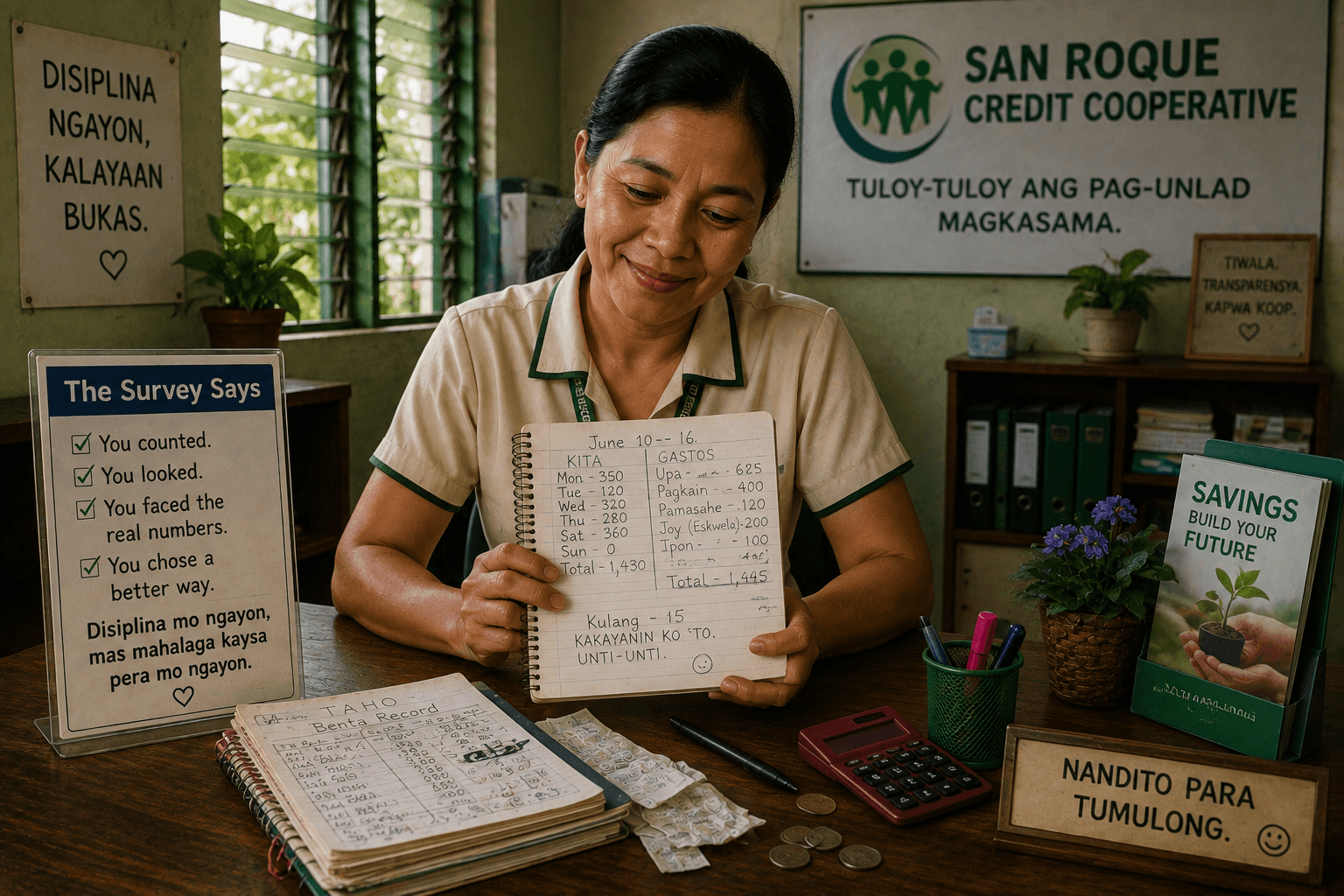
“I want to open an account,” Aling Nena said. Her voice was small but steady.
“How much can you start with?” the woman asked.
“One hundred pesos.”
The woman did not laugh. She opened a passbook, wrote Aling Nena’s name, and stamped it with a blue seal. “Welcome. We value discipline more than cash here. The amount is small. The habit is everything.”
Aling Nena walked out with the passbook in her hand. It weighed almost nothing. But it felt like armor.
Did you know?
Members of savings cooperatives are 40% less likely to use 5-6 lenders. Not because cooperatives give them more money, but because the cooperative teaches them to see their own money differently — as something to protect, not something to spend.
The Coach stood outside the cooperative, waiting.
“You did it,” she said.
“I was afraid they would say no.”
“They said yes because you came. The door is always open. But most people never walk through it.”
The Coach pointed to the passbook. “That is not just paper. That is proof. Proof that you believe in tomorrow. Proof that you are building something.”

📝 Lesson 4 Quiz — Mastery Check
What was the “Beautiful Trap”?
- A beautiful house she wanted
- A trap set by the Coach
- Buying a duster she did not need, emptying her tin can
- A loan from the cooperative
How did Aling Nena buy Joy’s phone?
- She used her hidden savings and waited until she had enough
- She borrowed from a 5-6 lender
- The Coach gave her the money
- She sold her taho cart
What did the cooperative value more than cash?
- Speed
- Beauty
- Size
- Discipline
How much did Aling Nena deposit to open her cooperative account?
- ₱50
- ₱100
- ₱87
- ₱200
According to “Survey Says,” why are cooperative members less likely to use 5-6 lenders?
- The government forces them
- They do not have emergencies
- The cooperative teaches them to protect their money
- They earn more money
✏️ Result Activity — Lesson 4
Your Turn:
Look at your spending from the last 7 days. Circle one purchase that was a “Beautiful Trap” — something that felt good in the moment but hurt you later.
Write one sentence: “Next time, I will wait 3 days before buying something I do not need.”
When you are ready, proceed to Lesson 5.
Lesson 5: The 90 Days
The Story
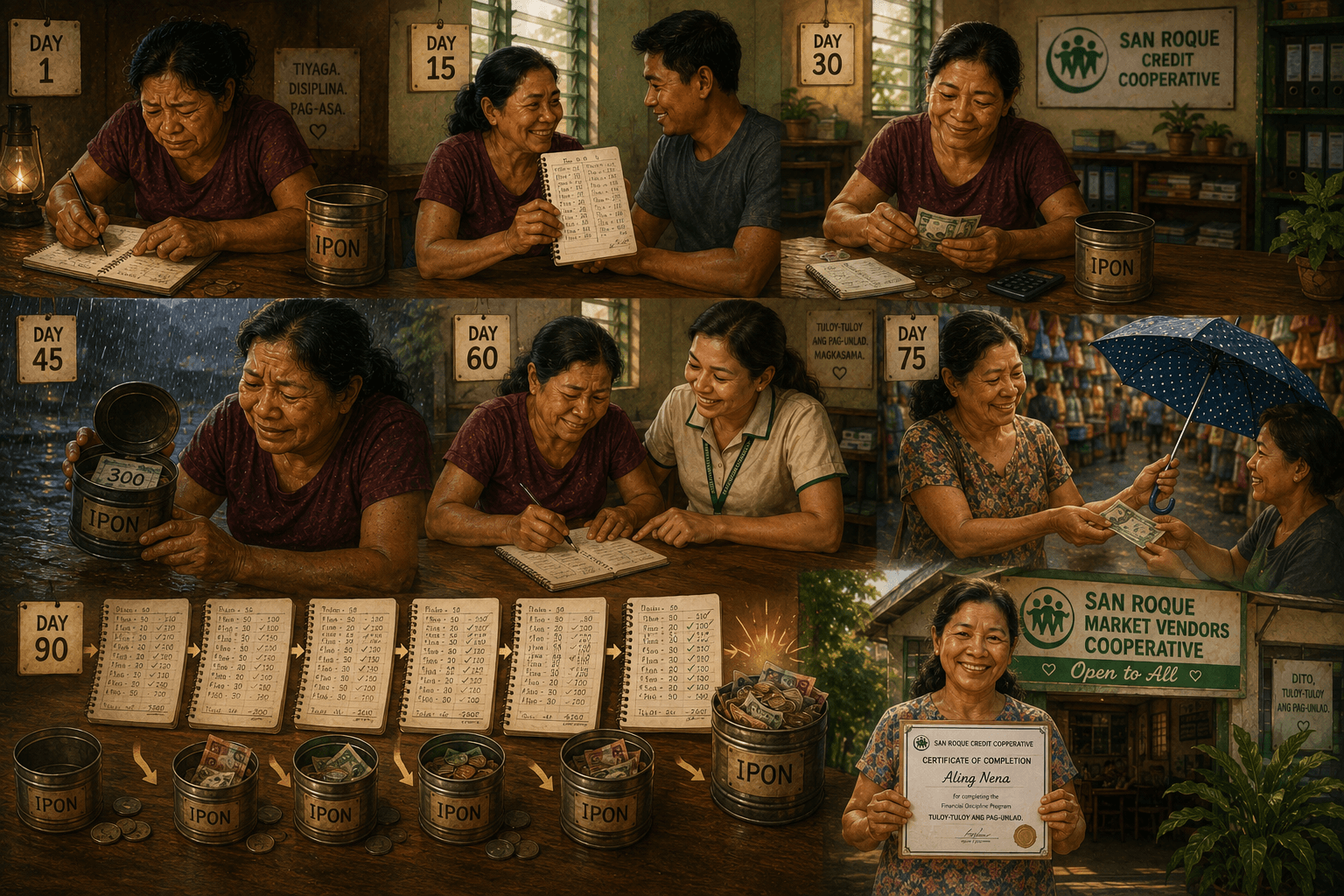
Ninety days.
Aling Nena opened her notebook and looked at the first page — the back of the electricity bill, shaky handwriting, the numbers that had started everything. Then she turned the pages. Week 2. Week 4. Week 8. Week 12.
The numbers told a story.
She saw the pattern now. Mondays and Thursdays were good days — San Roque Elementary, the children buying taho after school. Tuesdays were risky — rain came often. Saturdays were slow — everyone was at the market, not on the streets.
She saw her own habits too. When she was tired, she bought extra bread. When she was sad, she gave Joy treats she could not afford. When she was proud of a good day, she spent the extra instead of saving it.
But she also saw the walls she had built.
The medicine envelope had ₱340 now. The rice envelope had ₱280. Her cooperative passbook showed ₱650 — small, but growing. Her hidden-money place — an old biscuit tin under the floorboard — held ₱420 that she had almost forgotten.
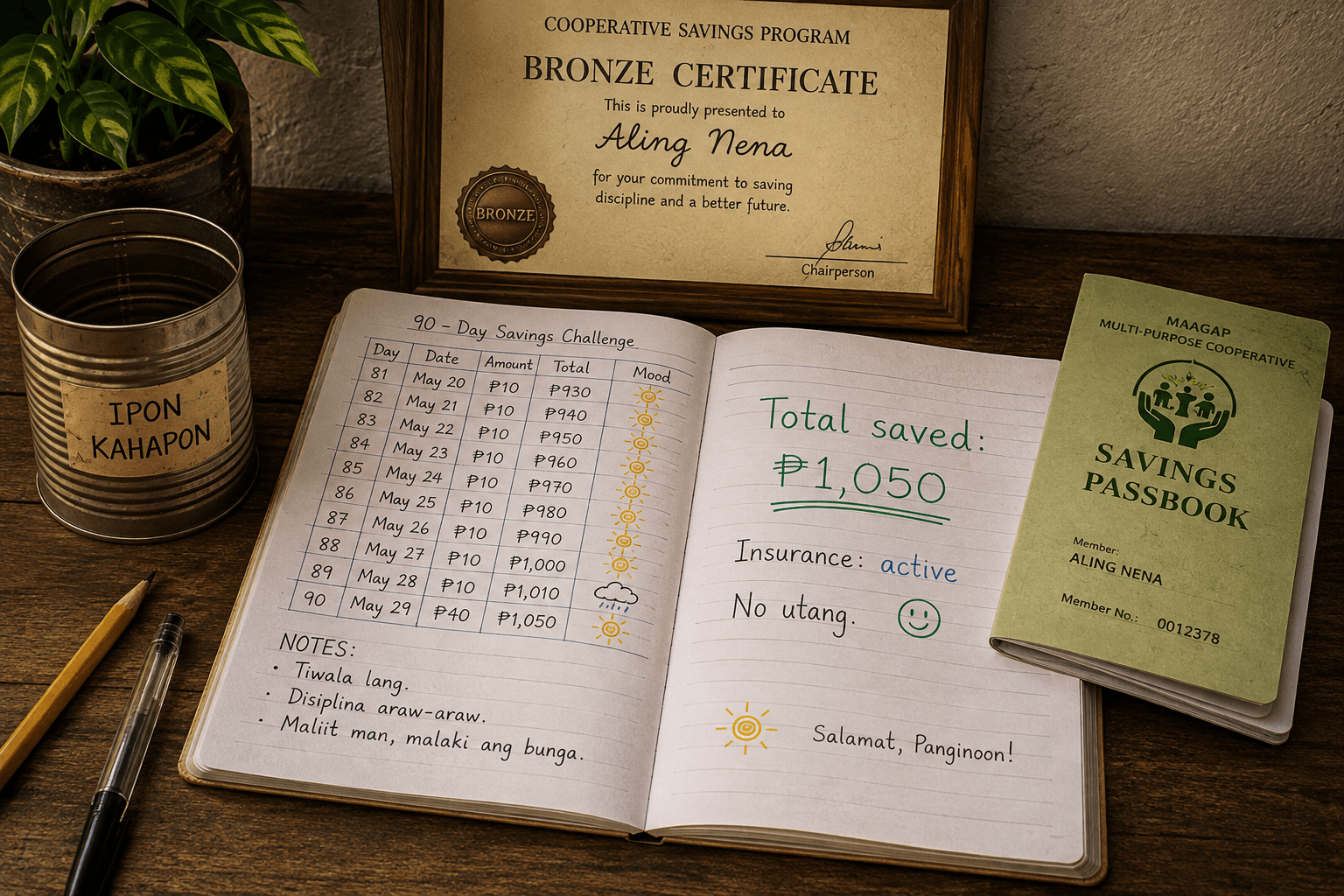
She was not rich. She was not even comfortable. But she was no longer blind.
One evening, Joy needed medicine again — a cough that would not stop. Aling Nena did not reach for the tin can behind the rice sack. She reached for her wallet. Inside was a small envelope labeled “MEDICINE.” She paid the pharmacy with calm hands. No panic. No borrowing. No tears.

The pharmacist smiled. “You are prepared, Aling Nena.”
“Not yet,” she said. “But I am learning.”
She walked home through streets that were no longer mud — the rainy season had passed. The sky was clear. Her steps were steady. She carried the pole, but she also carried something new: the knowledge that tomorrow could be planned, not just survived.
Did you know?
People who track their money for 90 days report the same three discoveries: (1) They spend more on small things than they thought. (2) Their “bad days” often follow the same pattern. (3) Their dignity grows not from having more, but from finally seeing clearly.
“Ninety days is not magic,” the Coach said. “It is just long enough for a habit to become part of you. You do not track because I told you to. You track because you saw what it gave you. That is the difference between obedience and ownership.”
📝 Lesson 5 Quiz — Mastery Check
How many days did Aling Nena track before reviewing her progress?
- 30 days
- 60 days
- 120 days
- 90 days
Which days were usually “good days” for selling taho?
- Mondays and Thursdays
- Tuesdays and Wednesdays
- Fridays and Saturdays
- Sundays only
How much was in Aling Nena’s cooperative passbook after 90 days?
- ₱100
- ₱650
- ₱340
- ₱420
When Joy needed medicine, what did Aling Nena use?
- The tin can behind the rice sack
- A 5-6 lender
- Her “MEDICINE” envelope
- She did not buy it
According to “Survey Says,” what is the third discovery people make after 90 days of tracking?
- They earn more than they thought
- They need a new job
- They should stop tracking
- Their dignity grows from seeing clearly
✏️ Result Activity — Lesson 5
Your Turn:
Look at your own tracking (from Lessons 1-4). What pattern do you see? What day is usually good? What day is usually bad? What do you buy when you are tired or sad?
Write your pattern down. Name it. When you name it, you can change it.
When you are ready, proceed to Lesson 6.
Lesson 6: The Cart Decision
The Story
Jose was a taho vendor too. Younger than Aling Nena. Stronger. Faster. He had a new cart — bright red, shiny wheels, a small umbrella. It was beautiful. It was also bought with a loan.

“Nena,” Jose said one morning, “you should get a cart like this. No more walking. No more sore shoulders. The lender gave me the money in one day. One day!”
Aling Nena looked at the cart. It was tempting. Her shoulders ached. Her feet were calloused. A cart would change everything.
“How much is the payment?” she asked.
“₱150 every week,” Jose said. “For one year.”
Aling Nena did the math in her notebook. ₱150 × 52 weeks = ₱7,800. The cart probably cost ₱4,000. Jose would pay almost double.
“And if you miss a week?” she asked.
Jose looked away. “I will not miss.”
But he did. Three weeks later, Aling Nena found him kneeling in the gutter, taho spilled everywhere, his cart gone. The lender had taken it back. Jose was crying, his hands empty, his pride broken.

“I just wanted to walk faster,” he said.
Aling Nena helped him up. She gave him a cup of taho from her bucket. She did not say “I told you so.” She did not need to. The gutter had already spoken.
That afternoon, Aling Nena made a decision. She would not borrow for a cart. She would save for one.
She opened her notebook and wrote:
Cart goal: ₱4,000
Current hidden savings: ₱420
Cooperative: ₱650
Need: ₱2,930 more
She calculated: if she saved ₱100 per week from her good days, she would have enough in 30 weeks. Seven months. No interest. No fear. No gutter.
Joy helped. On weekends, she carried the smaller bucket. “I am your cart, Nanay,” she said.
Aling Nena smiled. “You are better than any cart.”
Seven months later, Aling Nena bought her cart. Cash. No loan. No lender. She painted it blue — Joy’s favorite color.
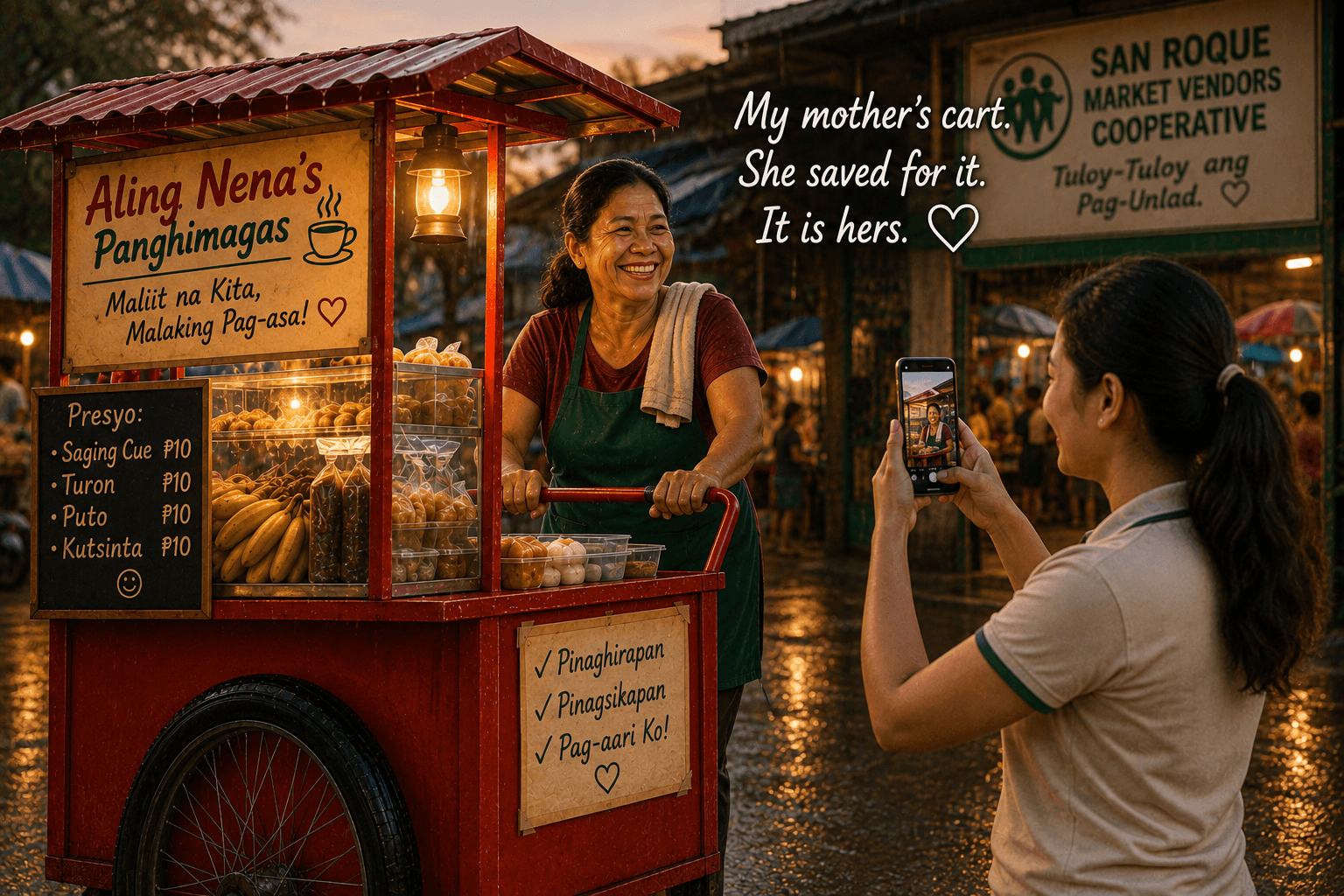
On the side, in small letters, she wrote: “Paid in Full.”
The first day she pushed it, the Coach walked beside her. The Coach was pushing a cart too — an old wooden one, ridiculous, wobbling, both of them laughing like children.


“This is what ownership feels like,” the Coach said.
“Heavy,” Aling Nena said, pushing uphill.
“Yes. But it is yours.”
Did you know?
Borrowers who take loans for “income-generating assets” (like carts, tools, or stalls) often lose the asset within 6 months because the weekly payments are higher than the extra income the asset produces. Saving first is slower. But it is safer. And it teaches you to own before you owe.
“The cart is not the victory,” the Coach said. “The decision is. Every time you choose saving over borrowing, you are voting for your future self. That vote is more powerful than any cart.”
📝 Lesson 6 Quiz — Mastery Check
How much would Jose pay in total for his cart loan?
- ₱7,800
- ₱4,000
- ₱10,000
- ₱5,200
What happened to Jose’s cart?
- It broke
- He sold it
- He gave it to Aling Nena
- The lender took it back when he missed payments
How did Aling Nena plan to buy her cart?
- Ask the Coach for money
- Sell her taho buckets
- Save ₱100 per week from good days
- Borrow from the cooperative
What did Aling Nena write on the side of her cart?
- “Taho for Sale”
- “Paid in Full”
- “Joy’s Cart”
- “Handa para sa kinabukasan”
According to “Survey Says,” why do many borrowers lose their “income-generating” assets within 6 months?
- The weekly loan payments are higher than the extra income
- The assets break easily
- The government takes them
- They do not work hard enough
✏️ Result Activity — Lesson 6
Your Turn:
Think of something you want to buy that costs more than you have right now. Write:
- The item and the total cost.
- How much you can save per week.
- How many weeks it will take to buy it with cash.
Now look at a loan option for the same item. Calculate the total you would pay with interest. Which is smaller — the saving time or the debt cost?
When you are ready, proceed to Lesson 7.
Lesson 7: The Final Survey & Certification
The Story
One year had passed since the rainy Tuesday.
Aling Nena stood at the barangay hall again. The same plastic chairs. The same banner. But she was not the same woman.
Her notebook was full — twelve months of numbers, patterns, lessons, and small victories. Her cooperative passbook held ₱3,200. Her hidden-money tin held ₱1,100. Her envelopes were fat with purpose. She had not borrowed from a 5-6 lender. Not once.
Joy was healthy. She had the phone. She was at the top of her class. And every Saturday, she helped her mother push the blue cart through the streets.

Ran stood at the whiteboard again. “Today,” he said, “we do the Final Survey. Not a test. A mirror. Look at where you started. Look at where you are. The distance between those two points is called growth.”
The survey was simple:
- Do you track your income and expenses?
- Do you save before you spend on good days?
- Do you have money set aside for emergencies?
- Have you avoided high-interest loans for 90 days?
- Do you believe you can build a better future?
Aling Nena answered yes to all five. Not because she was perfect. Because she had practiced. Because she had failed and tried again. Because the numbers had taught her that she was capable of more than she believed.
The Coach stood beside her, holding a certificate.
“Aling Nena,” the Coach said, “you have completed all seven lessons. You have passed every quiz. You have done every Result Activity. You have proven not that you are rich, but that you are ready.”
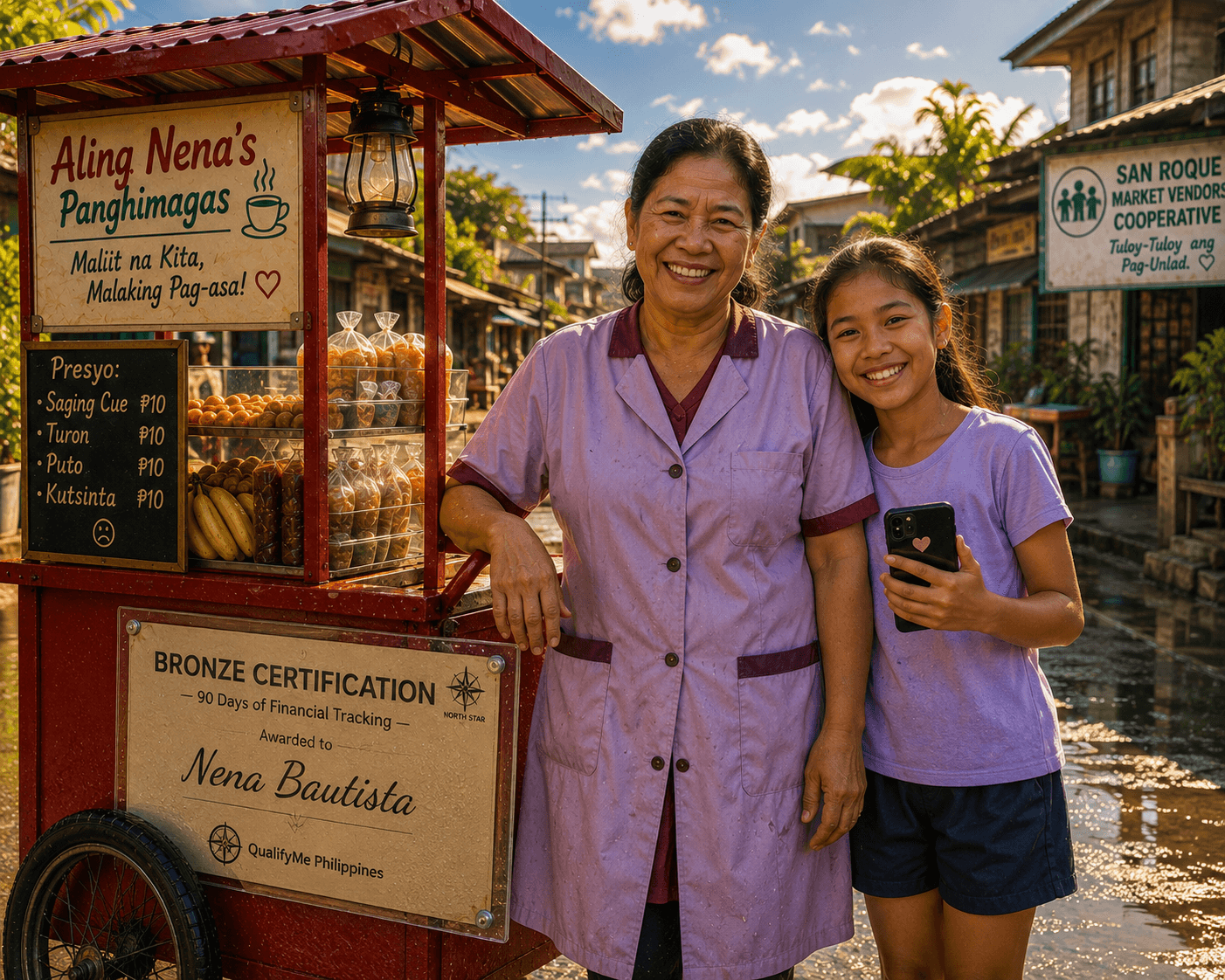
She handed her the certificate. It was simple — navy and gold, her name in clear letters, the words BRONZE CERTIFICATION across the top.
“This is not the end,” the Coach said. “This is the beginning. Bronze means you have built the foundation. Silver means you build the walls. Gold means you open the door. Platinum means you help someone else find the path.”
Aling Nena held the certificate with both hands. She thought of the rainy Tuesday. The empty tin can. The crying on the floor. The first shaky numbers on the back of an electricity bill.
She looked at the Coach. “Can I help Jose?”
The Coach smiled. “That is how Platinum begins.”
Did you know?
The most powerful predictor of financial improvement is not income level. It is not education. It is not luck. It is belief — the belief that small, consistent actions can change your future. Aling Nena believed. And belief, once practiced, becomes skill.
“You are not certified because you are perfect,” the Coach said. “You are certified because you stayed. You showed up. You tried. You failed. You tried again. That is the only qualification that matters.”
📝 Lesson 7 Quiz — Mastery Check
How long had passed since the rainy Tuesday?
- 30 days
- 6 months
- 90 days
- One year
How much was in Aling Nena’s cooperative passbook after one year?
- ₱650
- ₱3,200
- ₱1,100
- ₱4,000
What is the most powerful predictor of financial improvement, according to “Survey Says”?
- Belief that small actions can change your future
- High income
- College education
- Living in a big city
What does Bronze Certification mean?
- You are rich
- You can stop learning
- You have built the foundation
- You are better than others
What did Aling Nena ask at the very end?
- “Can I borrow money?”
- “Can I sell my cart?”
- “Can I help Jose?”
- “Can I stop tracking?”
✏️ Result Activity — Lesson 7
Your Turn:
Answer the Final Survey for yourself:
- Do you track your income and expenses?
- Do you save before you spend on good days?
- Do you have money set aside for emergencies?
- Have you avoided high-interest loans for 90 days?
- Do you believe you can build a better future?
Count your “yes” answers. If you have 3 or more, you are on the path. If you have fewer, that is not failure. That is your map.
When you are ready, proceed to the Crossword Puzzle.
🧩 Crossword Puzzle: Aling Nena’s Journey
Instructions: This puzzle tests your understanding of the story, not just your memory of words. You must get 8 out of 12 correct to earn your Bronze Certification.
If you get an answer wrong, your facilitator will give you a hint pointing to the lesson number. No punishment — just retry.
Across
- 1 Across — What Aling Nena carried on a wooden pole every morning (5 letters)
- 3 Across — The weather that trapped her at home on Tuesday (4 letters)
- 5 Across — Her daughter who got sick (3 letters)
- 7 Across — Where she opened her account with ₱100 (11 letters)
- 9 Across — Habit valued more than cash (9 letters)
- 11 Across — Container where she hid ₱87 (3 letters)
- 13 Across — Certification level she earned (6 letters)
Down
- 2 Down — The debt trap she learned to avoid (5 letters)
- 4 Down — Writing every peso daily (8 letters)
- 6 Down — The warm woman on the bench (5 letters)
- 8 Down — Money set aside on good days (7 letters)
- 10 Down — Proof displayed on her cart (11 letters)
- 12 Down — The Saturday session hall (8 letters)
📋 Mastery Rules
Student must answer 8/12 correctly to proceed.
Wrong answers: Facilitator gives hint pointing to lesson number. Allow retry.
No punishment. No shame. Only practice until understood.
🏆 Bronze Certification
Congratulations!
You have completed:
✅ All 7 Lessons
✅ All 35 Quiz Questions (100% correct)
✅ All 7 Result Activities
✅ Crossword Puzzle (8/12 or higher)
has successfully completed
QUALIFYME JOURNEY 1: ALING NENA
and has demonstrated understanding of:
- Income Tracking
- The Three Rules (Envelope, Hidden Money, Good Day/Bad Day)
- Cooperative Membership & Discipline
- Saving vs. Borrowing
- Pattern Recognition & Dignity in Small Wins
- Community Wisdom & Ownership
Certification Level: BRONZE
Date: _______________
Facilitator: _______________
🚀 What Comes Next?
| Level | Requirement |
|---|---|
| 🥉 Bronze | Complete Lessons 1-7 + all quizzes + all Result Activities |
| 🥈 Silver | Bronze + Emergency Fund Pathway (₱10,000 goal) |
| 🥇 Gold | Silver + Cooperative Loan application |
| 💎 Platinum | Gold + Mentor another learner |
“You are not finished. You are just beginning. The rainy Tuesday will come again — for you, for your neighbor, for someone you have not met yet. But now you have an umbrella. Now you have a map. Now you have a path.
Go build it. One brick at a time.”